
Stamped Concrete Vs Paving Stones: What Seattle Homeowners Should Know?

“Should I go with stamped concrete or pavers?”
It’s one of the most common questions we get at Raincity Pavers LLC and honestly, it’s a great one to ask before spending thousands of dollars on your outdoor space.
Here’s the truth: Pavers generally win for durability and long-term value, while stamped concrete is the more budget-friendly upfront choice. But the real answer depends on your home, your climate, and your priorities.
In this guide, we’re breaking down the full stamped concrete vs. pavers comparison cost, durability, maintenance, looks, and everything in between, so you can make a confident decision without second-guessing yourself.
Let’s get into it.
TL;DR
- Choose pavers if you want the best long-term durability, easier repairs, and higher property value.
- Choose stamped concrete if you’re looking for a lower upfront cost and a seamless decorative finish.
- Pavers typically last 30–50+ years, while stamped concrete lasts around 20–25 years with proper maintenance.
- Stamped concrete requires resealing every 2–3 years and can be difficult to repair if it cracks.
- Pavers cost more initially but individual stones can be replaced, making long-term maintenance more affordable.
- For Seattle’s rainy climate, pavers generally provide better drainage, flexibility, and performance during ground movement.
- The best choice depends on your budget, maintenance expectations, design preferences, and intended use.
Quick Answer
Pavers are generally the better choice for Seattle homeowners because they offer greater durability, easier repairs, better drainage, and a longer lifespan. Stamped concrete is a more affordable option upfront and creates a seamless decorative surface, but it is more susceptible to cracking and requires regular resealing to maintain its appearance.
What Is Stamped Concrete?
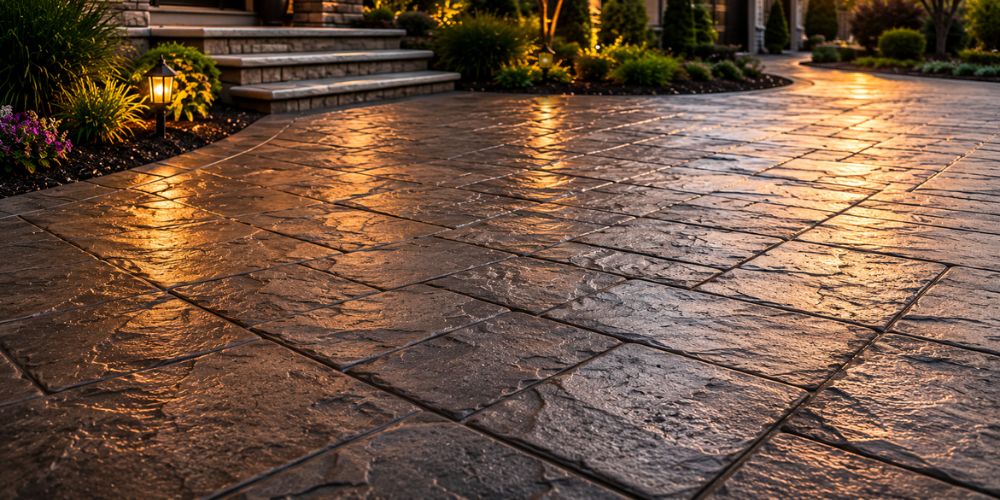
Stamped concrete is poured as a single, continuous slab. Before it hardens, contractors press patterns into the surface to mimic materials like slate, brick, cobblestone, or wood. Color is added through integral pigments or surface dyes.
The result is a smooth, seamless surface with no gaps or joints between pieces.
Advantages:
- Seamless surface — no joints or gaps
- Works beautifully for large, flowing patios and pool decks
- Handles curves, circles, and organic shapes with ease
- Can mimic materials that don’t exist as pavers (wood grain, random flagstone)
- Color is fully customizable at the time of pour
Limitations:
- Color can fade noticeably without regular resealing
- Pattern is imprinted, not three-dimensional like real stone
- Very hard to match if you extend the patio later — color batches vary
- One crack affects the visual continuity of the entire slab
What Are Pavers (Paving Stones)?
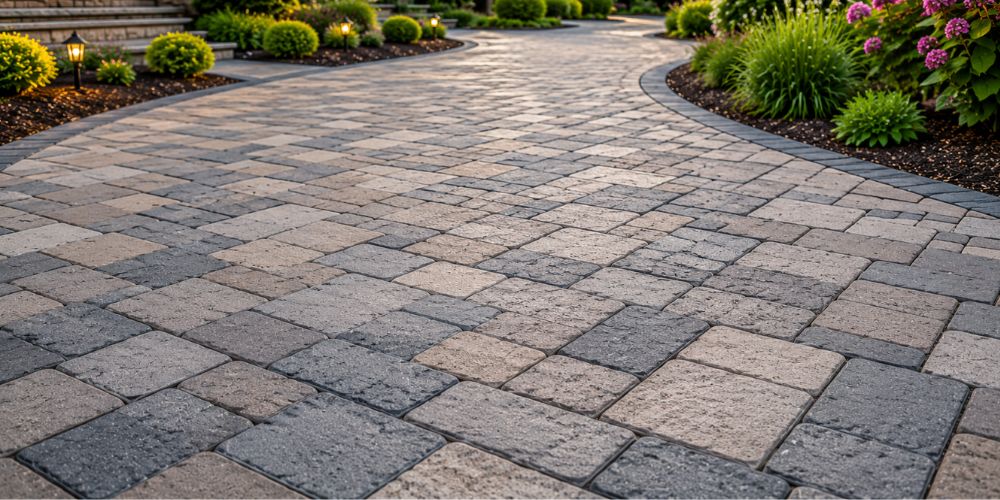
Pavers also called paving stones or interlocking pavers are individual units of concrete, brick, or natural stone laid on a compacted aggregate base. Each piece is placed separately, creating a modular, textured surface.
They interlock and flex with the ground rather than acting as one rigid slab.
Advantages:
- Real three-dimensional texture — each piece has depth and defined edges
- Wide variety from brands like Techo-Bloc, Belgard, and Cambridge
- Easy to replace a single damaged unit without affecting the rest
- Natural stone pavers (bluestone, travertine) have a premium look that’s hard to fake
- Age gracefully — often look better with time
Limitations:
- Joints between pieces collect debris and can grow weeds
- Complex curves require a lot of cutting and waste
- Color can vary between production batches if you add more later
- Frost heave or tree roots can shift individual pieces over time
Stamped Concrete vs. Pavers: Side-by-Side Comparison
| Feature | Stamped Concrete | Pavers |
| Upfront Cost | Lower ($8–$20/sq ft) | Higher ($15–$30/sq ft) |
| Long-Term Value | Moderate | High |
| Durability | Prone to cracking | Highly durable, flexible |
| Repairability | Difficult (visible patches) | Easy (replace one unit) |
| Maintenance | Reseal every 2–3 years | Occasional sand + sealing |
| Appearance | Seamless, uniform | Textured, natural variation |
| Lifespan | 20–25 years | 30–50+ years |
| DIY Friendly? | No | Partially |
| Slip Resistance | Lower when wet | Higher |
Cost: What Should You Expect to Pay?
Cost is often one of the biggest deciding factors for homeowners. Stamped concrete typically costs less upfront, while pavers require a larger initial investment but often provide better long-term value.
| Project Type | Stamped Concrete | Pavers |
| Patio | $8–$20 per sq. ft. | $15–$30 per sq. ft. |
| Walkway | $10–$18 per sq. ft. | $14–$28 per sq. ft. |
| Driveway | $12–$22 per sq. ft. | $18–$35 per sq. ft. |
Best for lower upfront cost: Stamped Concrete
Best for long-term value and repairs: Pavers
While stamped concrete is generally more affordable initially, pavers can save money over time because individual units are easier and less expensive to repair or replace.
Durability: Which One Holds Up?
This comes down less to the material and more to how it’s installed. Both stamped concrete and paving stones can last 25–30+ years — or fail within 5 years if the prep work is done poorly.
Stamped Concrete Durability
A properly poured stamped concrete slab uses:
- Reinforcement (rebar or fiber mesh) to distribute stress across the slab
- Control joints to direct any cracking to planned, inconspicuous locations
- Quality sealer to prevent moisture from penetrating and causing surface spalling
The weakness:If a significant crack develops due to soil movement, tree roots, or freeze-thaw,it runs across the visible surface. Repairs are possible but rarely invisible.
Paver Durability
Pavers sit on a flexible sand-and-aggregate base, which means:
- The surface can accommodate ground movement without cracking individual pieces
- Frost heave pushes individual pavers rather than splitting them
- One damaged unit can be pulled up and replaced without touching anything around it
The weakness: If the base prep is inadequate, pavers can shift, sink, or develop trip hazards. The base is everything.
Verdict: Both materials are durable when installed correctly. Pavers have the edge on repairability fixing a cracked paver is a 15-minute job; fixing a cracked slab is an expensive, imperfect patch.
Maintenance: The Real Long-Term Difference
This is the factor that surprises most homeowners most.
Stamped Concrete Maintenance
- Reseal every 2–3 years to protect color and prevent surface damage
- Clean periodically with a hose or low-pressure wash
- Avoid de-icing salt — it damages the surface finish
- That’s essentially it. No weeds, no shifting, no re-sanding.
Paver Maintenance
- Re-sand joints every 1–2 years — polymeric sand washes out, especially in rainy climates
- Weed control — even good polymeric sand lets some weeds through over time
- Re-level shifted pavers after freeze-thaw cycles or root intrusion
- Seal periodically to maintain color vibrancy and stain resistance
- Manage edge restraints — borders can creep outward over time if not properly anchored
Pavers look low-maintenance when fresh but require consistent upkeep. Stamped concrete is simpler day-to-day but absolutely needs that resealing cycle to stay looking good.
Which Is Right for Your Project?
Choose Stamped Concrete If:
- Budget is your top priority upfront
- You want a seamless, modern look for a large patio or pool deck
- Your design includes curves, circles, or flowing shapes
- You’re okay committing to resealing every 2–3 years
- The area is covered or partially sheltered (less weather exposure = less fading)
Choose Pavers If:
- You want easier long-term repairs (one unit at a time, not slab patches)
- You’re in an area with a lot of tree roots or ground movement
- You need to phase construction over time and want to easily extend later
- You prefer the three-dimensional, natural look of individual pieces
- You have utilities running under the area (pavers can be lifted and relaid)
- You want premium natural stone — real bluestone or travertine is hard to replicate
Consider Combining Both
Some of our favorite projects mix materials strategically:
- Stamped concrete patio with a paver border and seating wall cap
- Paver driveway with a stamped concrete front walkway
- Stamped concrete pool deck with natural stone coping
Combining materials gives you the benefits of both — and creates visual contrast that looks intentional and high-end.
5 Questions to Ask Any Contractor Before You Sign
Whether you go with stamped concrete or paving stones, these questions will protect you:
- What base preparation do you use? For patios, minimum 4 inches of compacted aggregate. For driveways, 6+ inches. Shortcuts here cause failures within a few years.
- Do you use reinforced concrete? For stamped work, rebar or fiber mesh is non-negotiable for a long-lasting slab.
- What’s the sealer you’re applying? A quality penetrating or film-forming sealer matters. Some contractors skip this entirely to save cost.
- Can I see recent local projects similar to mine? Any experienced contractor should have a current portfolio and references nearby.
- Are you licensed and insured? Always ask. Don’t skip this one.
Frequently Asked Questions
Is stamped concrete cheaper than pavers?
Yes, stamped concrete typically runs 30–40% less than a comparable paver installation upfront. However, over 10 years, resealing costs narrow the gap. Pavers often deliver better long-term value due to easier, cheaper repairs.
Do pavers last longer than stamped concrete?
Both can last 25–30+ years with proper maintenance. Pavers have an edge because individual units can be replaced without disrupting the rest of the surface. A cracked stamped concrete slab is harder and more expensive to repair invisibly.
Which is better for a driveway — stamped concrete or pavers?
Both work for driveways. Pavers are generally preferred for heavy vehicle areas because the flexible base absorbs stress better. Stamped concrete is a great option too when properly reinforced and sealed.
Is stamped concrete slippery when wet?
Sealed stamped concrete can be slippery, especially when wet. Quality contractors add non-slip aggregate to the sealer to improve traction. Pavers with textured surfaces generally offer better natural grip.
Can stamped concrete be repaired if it cracks?
Yes, but repairs are often visible. Matching the original color and texture exactly is difficult. A skilled contractor can minimize the appearance, but a perfect invisible repair is rarely achievable.
The Bottom Line
Stamped concrete and pavers both create beautiful, long-lasting outdoor spaces. Neither is universally “better” — the right choice depends on your budget, your design goals, and how much ongoing maintenance you’re willing to do.
Our honest take: For driveways, high-traffic walkways, and anyone who wants minimal long-term hassle, pavers are the smarter long-term investment.
For large patios, seamless pool decks, or tighter budgets, stamped concrete absolutely holds its own.
If still you are not sure which is right for your specific project? That’s exactly what Raincity Pavers LLC here for. We’ll visit your space, talk through your options honestly, and give you a detailed quote for both , so you can compare and decide with zero pressure.